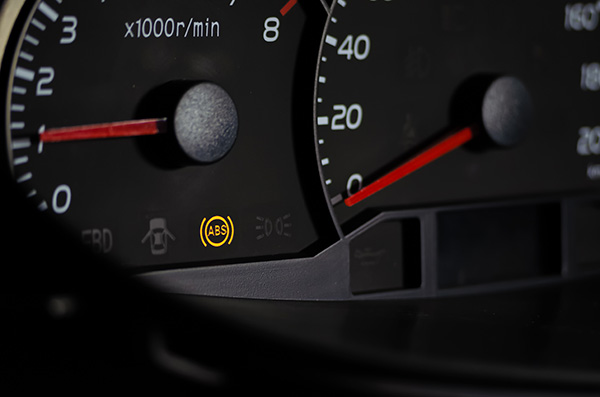
Seeing one warning light is annoying. Seeing three come on at once feels like the dashboard is trying to start an argument. ABS, traction control, and stability control warnings often appear together because those systems share information.
One bad signal can upset all three.
The brakes may still work, and the car may still drive, but the safety features that help during hard stops, slick roads, and sudden steering corrections may not be fully available. That makes the warning worth checking sooner rather than later.
These Systems Share Wheel Speed Data
ABS, traction control, and stability control all need to know how fast each wheel is turning. The ABS uses that information to help prevent wheel lockup during hard braking. Traction control uses it to reduce wheel spin. Stability control uses it to help the car stay on the path the driver intends.
If one wheel speed reading drops out, looks incorrect, or does not match the others, the vehicle may shut off several systems at once. That is why the warning lights often appear together.
From the driver’s seat, it can seem like three separate problems. In many cases, the issue starts with one shared input.
A Bad Wheel Speed Sensor Is Common
Wheel speed sensors are one of the most common causes of these lights coming on together. Each sensor reads wheel movement and sends that data to the vehicle’s computer system. If a sensor fails, gets dirty, has damaged wiring, or loses signal, the systems cannot trust the data.
Sometimes the warning lights come on and stay on. Other times, they appear after driving a few miles, hitting a bump, or turning in a certain direction. That can happen when the wiring is loose or the signal drops in and out.
A scan tool can usually show which wheel is reporting the issue. The sensor still needs to be tested because the problem may be the sensor, the wiring, the connector, or the part the sensor reads.
Tone Rings And Wheel Bearings Can Also Cause Problems
The wheel speed sensor does not work on its own. On many vehicles, it reads a tone ring or magnetic encoder built into the hub or wheel bearing. If that part is cracked, rusted, dirty, damaged, or worn, the sensor may send a bad signal even if the sensor itself is fine.
A failing wheel bearing can create similar trouble. The bearing may have play, noise, or internal damage that affects the wheel speed reading. Drivers may hear a humming, grinding, or growling sound that changes with speed.
This is where an inspection matters. Replacing only the sensor will not fix the warning lights if the hub, bearing, or tone ring is the real cause.
Low Battery Voltage Can Confuse The System
Modern safety systems depend on stable voltage. A weak battery, failing alternator, poor ground, or corroded connection can cause several warning lights to appear at once. The lights may show up after startup, during cold weather, or after the vehicle has been sitting.
Low voltage can make modules lose communication or report faults that seem unrelated. That does not mean the ABS itself has failed. It may mean the electrical system is not giving it clean power.
Our technicians check battery condition, charging output, grounds, and stored codes when multiple lights appear together. A weak electrical foundation can make a good system look bad.
Steering Angle And Yaw Sensors Play A Role
Stability control needs more than wheel speed. It also uses steering angle, yaw rate, brake pressure, and acceleration data to understand the vehicle's behavior. If the steering angle sensor loses calibration or sends incorrect information, the system may turn on warning lights.
This can happen after alignment work, steering repairs, suspension repairs, battery disconnection, or a hard impact. A vehicle that pulls, has a crooked steering wheel, or has recently hit a curb may need both mechanical checks and sensor calibration.
Stability control is only useful when it knows where the driver is trying to steer. If that data is wrong, the system may disable itself.
Brake System Issues Can Trigger The Lights
ABS is directly tied to the brake system, so brake-related problems can trigger warning lights too. Low brake fluid, a failing ABS module, hydraulic pump issues, damaged wiring, or a brake pressure sensor fault can all be involved.
If the red brake warning light is on along with ABS, traction control, or stability control, take it more seriously. That can point to a hydraulic or fluid-level concern, not just a sensor signal problem.
The brake pedal feel matters here. A soft, low, or changing pedal should be checked right away. Do not treat brake warning lights as normal dashboard clutter.
Tires And Alignment Can Add To The Confusion
Tire size, tread depth, pressure, and uneven wear can affect how these systems read wheel behavior. If one tire is much smaller, underinflated, mismatched, or badly worn, the system may see wheel speeds that do not make sense.
This is especially common after replacing only one tire on some vehicles or driving too long with one tire low. Alignment and suspension wear can also affect stability control if the vehicle is not tracking correctly.
Regular maintenance should include tire pressure checks, tread checks, and a look at suspension wear. Those simple checks can prevent warning lights that start with a mechanical issue.
Get ABS, Traction Control, And Stability Control Service In Plano, TX, With Davenport Motor Company
If your ABS, traction control, and stability control lights are on, Davenport Motor Company in Plano, TX, can check the sensors, wiring, wheel bearings, battery voltage, brake system, and related safety systems.
Schedule a visit and find out whether the warning started with one bad signal or a deeper brake or electrical problem.