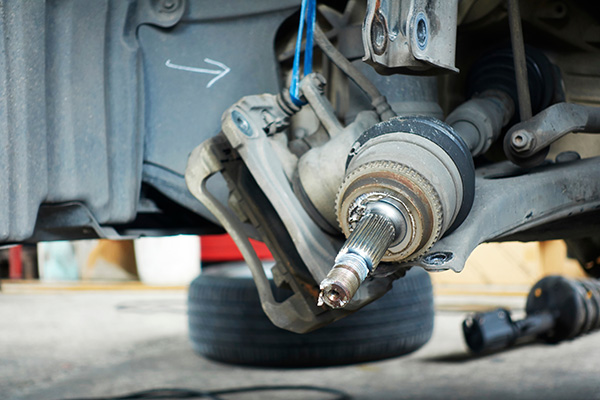
A grease stripe inside the front wheel can be the first visible sign of a torn CV boot. The Toyota still drives quietly. When the repair estimate offers either a boot kit or a complete axle, the cheaper-looking part doesn't necessarily make the decision simple.
You're comparing two different jobs. One preserves the checked original joint. The other replaces the assembly. The sensible choice depends on what the torn boot exposed, the available parts, and the labor needed to do either repair properly.
A Quiet Original Joint Can Be Worth Saving
The boot protects the constant velocity joint by retaining grease and keeping out water and grit. It doesn't transmit the engine's torque itself. If the rubber has split but the joint remains undamaged, replacing the protective cover can restore its seal without discarding the axle.
Toyota supplies model-specific boot kits for various applications, so a complete axle isn't the only service option. Availability and procedure still need to be checked for the exact vehicle. A good original joint is worth evaluating rather than assuming its age makes it inferior to every replacement assembly.
Grease on the Wheel Doesn't Date the Tear
A rotating axle can spread grease quickly. A large mess doesn't prove the boot has been open for months, and a small mess doesn't prove the joint is clean inside. A split near a fold can also open and close as the suspension moves, changing how much grease escapes.
At our shop, we base the decision on retained lubrication, contamination, and joint condition rather than the size of the stain. Watery or gritty grease raises concern even if no clicking has started. A boot that still contains grease can nevertheless have admitted dirt, especially if the vehicle has been driven through water or on dusty roads.
The Joint Needs More Than an Outside Look
A proper boot job requires access, cleaning, and examination of the joint before installing fresh grease. Damaged bearing surfaces, pitting, rough movement, or abnormal looseness can make it unsalvageable. That condition isn't always visible with the axle still installed and the old boot covering the joint.
You also need to distinguish normal joint movement from wear. The inboard joint is designed to slide as suspension position changes, so movement alone doesn't make it defective. Ask whether the boot estimate allows you to check the joint and what the next step would be if you find damage during disassembly.
Clicking or Load-Related Shudder Changes the Discussion
Repeated clicking during a tight powered turn is associated with outer CV joint wear. An inner joint can instead produce a shudder during acceleration. Once internal wear is confirmed, installing new rubber and grease won't restore the worn metal surfaces.
You still need to locate those symptoms before ordering parts. An acceleration vibration can also come from mounts or other driveline components, and a turning noise can originate in steering or brake hardware. The strongest case for axle or joint replacement combines a reproduced symptom with matching physical evidence, rather than relying on a familiar sound alone.
Compare Complete Jobs, Not Just Parts Prices
Boot replacement adds disassembly, cleaning, packing the correct grease, and fitting the boot and clamps. On some Toyotas, that labor narrows the difference between boot service and axle replacement. On others, preserving a sound original assembly remains a reasonable value.
Ask for estimates that describe what is being supplied, not simply one price labeled axle and another labeled boot. The comparison should make these details clear before you choose:
- Whether the existing joint will be cleaned and examined
- Which boot kit, grease, and clamps will be used
- The source and warranty of a replacement axle
- Whether the other boot has cracking or leakage
- Any additional work needed if joint damage is uncovered
A low-priced assembly isn't automatically poor, and an original axle isn't automatically worth saving. Fit, joint quality, and the work needed to install the part belong in the same conversation as cost.
Early Boot Service Is Different From Hiding Wear
An intact boot needs enough flexibility and correct positioning to follow the joint without pulling tight or folding incorrectly. The proper grease and clamp installation help keep it sealed. A generic cover that doesn't fit the application isn't an equal substitute for a correctly installed kit.
Checking the boots during regular maintenance gives you a better chance of finding a tear before noise develops. Once you find a tear, avoid unnecessary mileage while the joint's condition is assessed. A prompt inspection can preserve the option of boot service, but it cannot guarantee that contamination hasn't already caused damage.
Get Toyota CV Boot And Axle Service In Plano, TX, With Davenport Motor Company
Davenport Motor Company in Plano, TX, can evaluate the boot, grease, and joint condition before you decide whether to retain the original axle.
Contact us to discuss Toyota CV boot service and compare repair options for your vehicle.