We have all been there: you climb into your car, turn the key, crank the climate control, and wait for that crisp arctic breeze. Instead, you get a breath of air that feels exactly like the ambient temperature outside. When your air conditioning stops working, the prime suspect is almost always a refrigerant leak—often still called Freon in everyday conversation, though modern cars use newer chemicals like R-134a or R-1234yf.
At our shop, we deal with a flood of A/C issues as soon as the weather warms up. Many drivers treat a lack of cold air as a minor annoyance, planning to look into it whenever they get a free weekend. However, an A/C leak is a bit different from a broken radio or a cracked cup holder. It involves a high-pressure chemical loop that directly affects other parts of your car.
Today, we want to walk you through how to spot a leak, why ignoring it is a bad idea, and what the real-world numbers look like when it comes time to pay the bill.
The Signs: How to Catch a Freon Leak Early
Refrigerant is a bit of a ghost. Under normal conditions, it transitions between a gas and a liquid inside your A/C lines. Because it evaporates instantly when it hits the open air, you will rarely see a colorful puddle of Freon sitting on your driveway as you would with bright green coolant or dark engine oil.
Instead, you have to look for the secondary clues your car drops:
The Gradual Fade: Your A/C does not just stop working overnight; it slowly loses its punch over a few weeks or months until it is blowing thoroughly lukewarm air.
The Invisible Wet Spot: Refrigerant travels through your system mixed with a special lubricating oil. If a hose or connection is leaking, you might notice a greasy, dirt-attracting film on the metal lines or around the A/C compressor under the hood.
A Hissing Sound: If you have a significant leak, you might hear a faint, distinct hissing noise coming from behind the dashboard or the grille for a few seconds after you shut off the engine.
The Rapid Cycle: Listen closely when you turn on the A/C. If you hear the engine bay clutch constantly clicking on and off every few seconds, the system pressure is likely too low to stay engaged.
The Dangers: Why It’s More Than Just a Comfort Issue
It is easy to think that driving without A/C is just an exercise in sweating, but letting a leak linger can cause serious physical damage to your car.
First and foremost is compressor failure. The compressor is the heart of your climate control system, and it relies entirely on the oil suspended within the refrigerant to stay lubricated. When the Freon leaks out, that vital oil leaves with it. Running an A/C compressor without oil is exactly like running an engine without motor oil—the internal metal parts will grind together, overheat, and violently seize up. What could have been a simple leak fix can quickly cascade into a total system meltdown.
There is also an environmental aspect. Older automotive refrigerants destroy the ozone layer, while modern versions act as potent greenhouse gases. Allowing these chemicals to continuously vent into the atmosphere from a damaged hose is something every responsible car owner should avoid.
Breaking Down the Repair Costs
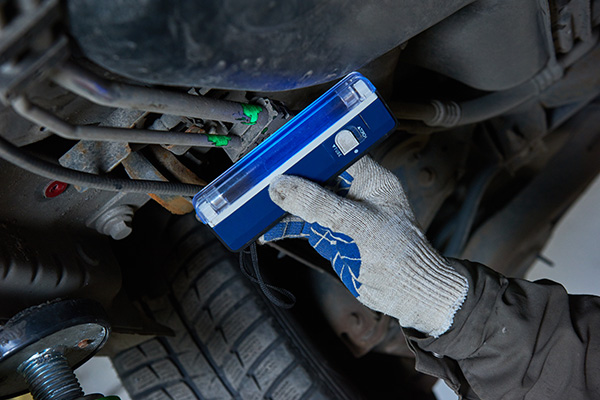
Let's address the elephant in the repair bay: What is this going to run me? Because an A/C loop winds through the entire front half of your car, the cost depends entirely on where the leak is hiding. During diagnostics, we inject a glowing UV dye into the system to visually pinpoint the exact escape route.
Once the leak is found, the repair costs generally fall into three distinct tiers:
The Quick Fix ($150 – $400): If the leak is caused by a dried-out rubber O-ring, a loose Schrader valve, or a single accessible hose, the fix is relatively straightforward. This price range typically includes replacing the faulty seal and performing a standard A/C recharge to restore your fluid levels to factory specifications.
The Mid-Tier Repair ($450 – $900): If a rock flew through your grille and punctured your A/C condenser (the mini-radiator at the front of your car), the part itself and the labor required to remove the front bumper will push the price up.
The Worst-Case Scenario ($1,000 – $2,000+): If the leak is buried deep inside your dashboard within the evaporator core, or if the compressor has completely locked up and contaminated the entire system with metal shavings, the repair requires significant labor and premium replacement hardware.
Avoid the Driveway Band-Aids
We understand the temptation to grab a quick-fix can of refrigerant from a local retail store. However, we see these DIY cans backfire constantly.
Most of them contain chemical stop-leak additives designed to swell old rubber seals. While that sounds great in theory, those glues can clog the tiny passages inside your A/C system and gum up professional shop equipment. Even worse, without manifold gauges, it is incredibly easy to overcharge the system, which can instantly blow out a perfectly good compressor.
Let Us Track It Down
Your climate control system is complex, highly pressurized, and requires specialized tools to service safely. If your car is starting to lose its chill, don't wait for the system to cook itself. Bringing it in early to Davenport Motor Company in Plano, TX can mean the difference between a simple hose replacement and a multi-thousand-dollar overhaul.
Give us a call or book an appointment online today. We will locate the leak, seal the system, and get your vents blowing ice-cold air again.